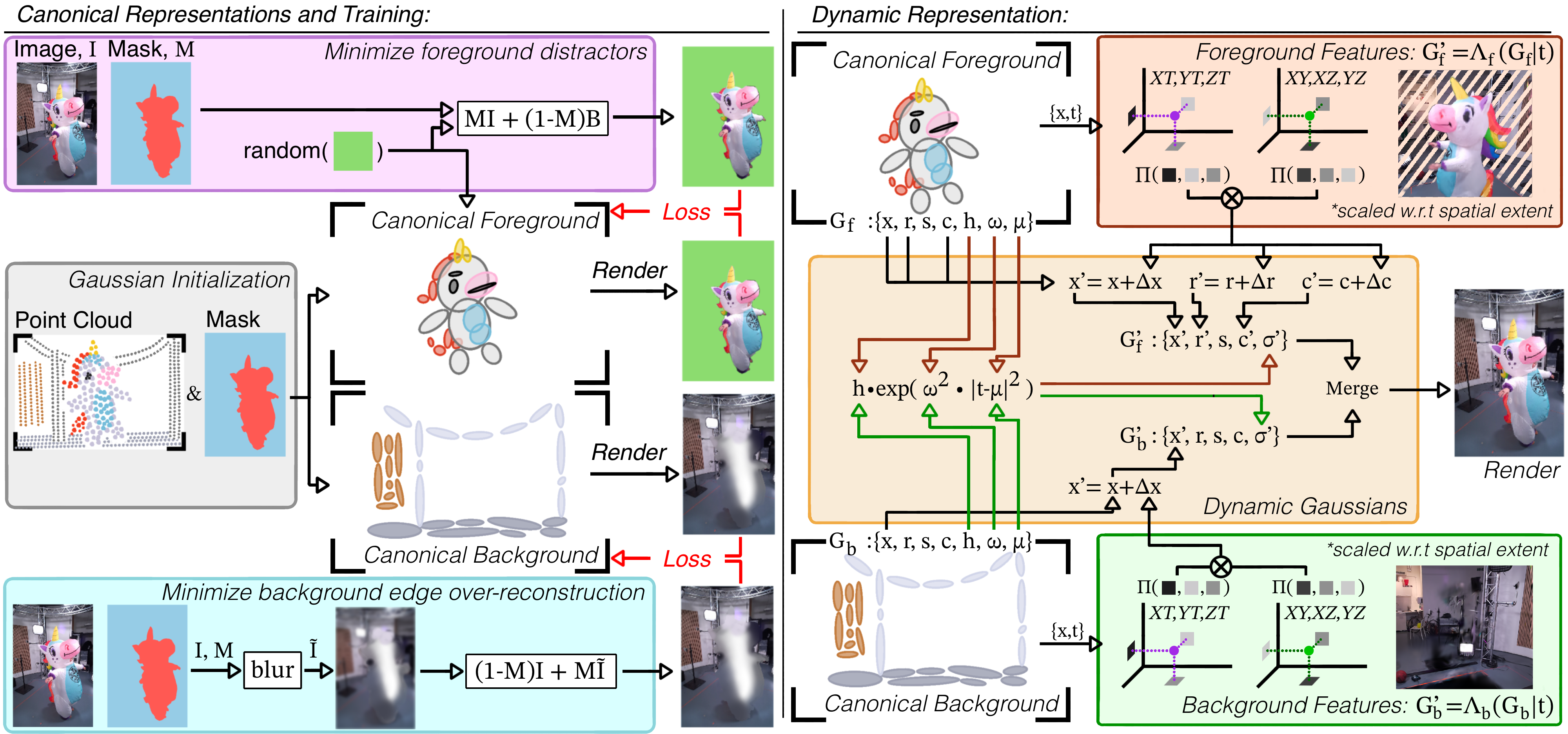
This primary focus is to tackle relighting scenes that contain real in-camera IBL (RIC-IBL) sources by:
(1) Introducing a new 3-D reconstruction and relighting pipeline - using Gaussian Splatting
(2) Producing a several datasets to support future work
This application area is Virtual Production (VP) as:
(1) VP relies on RIC-IBL sources for in-camera lighting effects
(2) VP is extremely costly and so the proposed model works towards more accessible filmmaking
(3) VP technology is primitive with a high reliance on pre-production and background and lighting design. So, production pipelines do not yet
consider the variety of tasks that could be automated. This includes photorealistic footage relighting.
As we tie together Graphics, VS filmmaking and Gaussian Splatting, it is important to outline what this paper is and is not.
This paper is:
(1) An attempt to provide lighting editability and customisability in post-production
(2) An novel attempt at VSR with a focus on producing arbitrary output variables (AOVs)
(3) A geometry-independent approach to relighting real static 3-D scenes using Gaussian Splatting
(4) Attempting to provide additional baselines to support objective studies and future work
This paper is not:
(1) An approach to 3-D inverse rendering - we do not model material properties like albedo/roughness
(2) A synthetic lighting pipeline for GS - we do not rely on synthetic light sources for relighting
(3) An active solution to VSR. This is new research - a couple of steps exist between here and actual application.